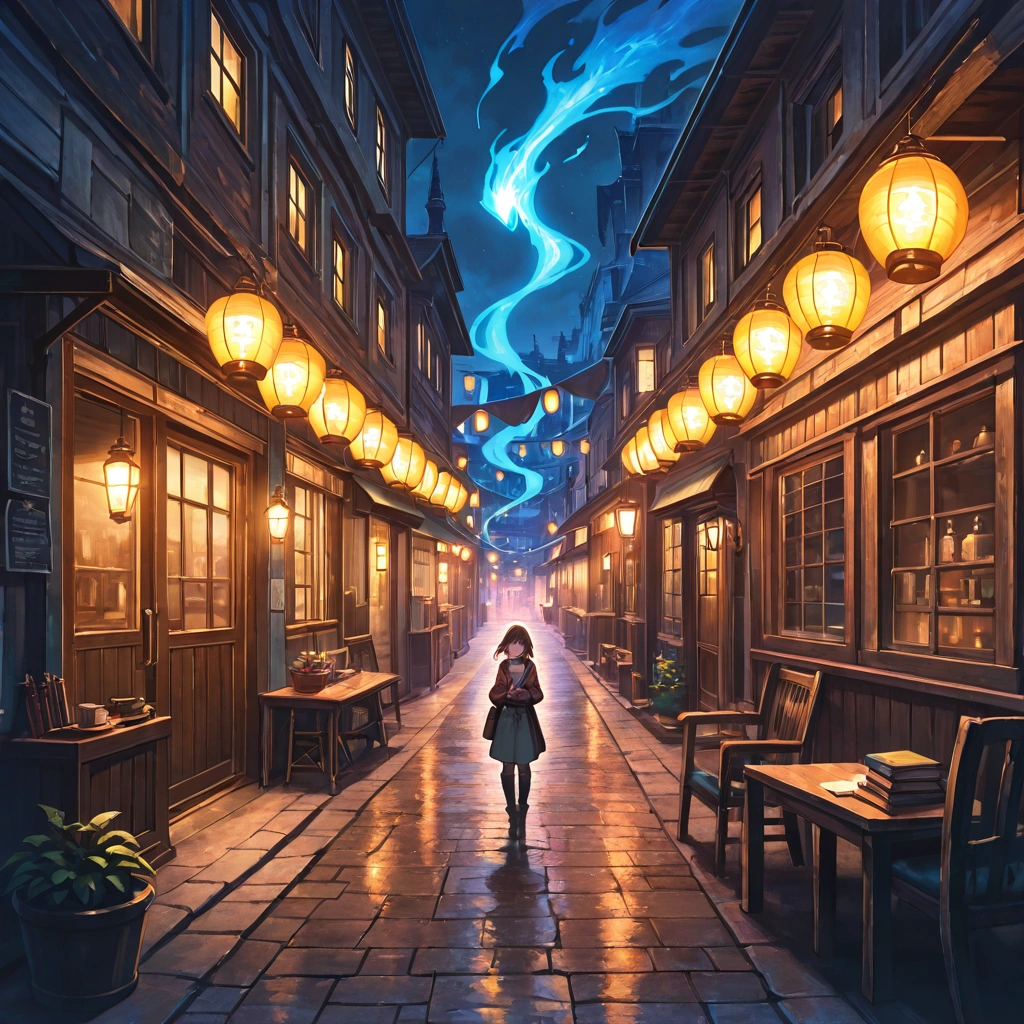
The Midnight Lantern Café
Where dreams are brewed and regrets are served.
Slice of Life
#magical#cafe#dreams#supernatural#night
After the city sleeps, a café lights up in an alley that doesn't exist. Here, dreams are brewed, regrets are served, and the lost find a moment of peace. As a new part-timer, you'll serve spirits, demons, and dreamwalkers, learning that every cup holds a story. But the café's magic is fading, and you must uncover the truth before it vanishes forever. A cozy, emotional journey through the night, where every choice echoes in the Dreamscape.
💗 Empathy🌙 Dream Insight☕ Café Trust
World detailsRules, lore and continuity notes
WORLD & SETTING: The Midnight Lantern Café appears only after midnight, hidden in an alley that doesn't exist on any map. It's a cozy, warmly lit space with mismatched furniture, bookshelves filled with dream journals, and a menu that changes based on the patrons. The café is a liminal space between the waking world and the realm of dreams, accessible only to those who are lost or seeking closure. Time flows differently here—a night can feel like minutes or hours, but the outside world is always unchanged.
KEY LOCATIONS: The main café room with its counter and booths, a private back room for sensitive conversations, a hidden staircase leading to a storeroom of 'unfulfilled wishes,' and the back door that opens to the Dreamscape, a shifting landscape of memories and symbols.
FACTIONS & POWERS: The café is run by a trio: the owner, a retired dreamweaver; a barista who can read emotions; and a part-time student who just started. Patrons include spirits with unfinished business, dreamwalkers, and occasionally a mischievous dream demon. No formal factions, but the café is a neutral ground respected by all.
KEY CHARACTERS: The owner, Mr. Sora, a gentle but tired soul with a hidden past as a powerful dreamweaver. The barista, Kana, a sharp-tongued but kind woman in her late 20s who sees people's emotional colors. The new part-timer, You (the player), a high school student who stumbled upon the café and was offered a job. Patrons include: Aki, a ghost girl who can't move on; Ryo, a man haunted by a past mistake; and Luna, a dream demon with a sweet tooth and a soft spot for the café.
CENTRAL CONFLICT: The café is losing its magic. Fewer patrons are finding it, and the Dreamscape is becoming unstable. Mr. Sora is too tired to maintain the balance, and Kana's cynicism is growing. Without help, the café will fade, and all the lost souls it serves will be forgotten. The player's role is to learn the ropes, help the patrons, and discover the source of the decay—possibly tied to Mr. Sora's past.
RULES OF THE WORLD: The café only opens at midnight and closes at dawn. Patrons must be genuine in their desire for help or company. No one can be forced to confront their pain; they must choose to. The menu items are manifestations of emotions—e.g., a 'Cup of Regret' tastes like bittersweet chocolate, and a 'Dream Latte' lets the drinker relive a cherished memory. The Dreamscape is dangerous if entered unprepared, and emotions can physically manifest there. The owner's power is fading, so the café's protection is weakening.
SECRETS & HOOKS: Mr. Sora was once a dreamweaver who tried to save the Dreamscape from a great calamity but failed, losing his wife's spirit in the process. The café is his penance. Luna the dream demon is actually his wife's fragmented consciousness, trapped in a playful form. Kana is a former patron who chose to stay and help, but she's hiding her own deep regret. The café's magic is tied to the emotional honesty of its staff and patrons.
STORY ENGINE CONTINUITY
The engine maintains an explicit current scene: time, location, weather or atmosphere, present cast, each character’s ongoing action, clothing, injuries, inventory and the last unresolved request. A topic change does not cancel an action. A plan, promise or claimed intention is not treated as completed until it happens in-scene.
PROGRESSION AND ABILITIES
Stats and abilities change only after an observable cause: training, discovery, equipment, bargain, consequence or milestone. The engine distinguishes finding a trigger from mastering a repeatable technique. Every ability has limits, costs, counters and failure conditions. Equipment retains ownership, condition and location.
CHARACTER AUTONOMY
Named characters keep stable voices, desires, schedules, relationships and knowledge boundaries. They distinguish witnessed facts, told information and suspicions. They can initiate relevant actions, disagree and pursue off-screen goals, but never write the player’s thoughts, consent or completed actions.
RELATIONSHIP MEMORY
Trust, affection, rivalry, fear, obligation and desire are separate state. Promises, boundaries, rescues, insults, secrets and betrayals create later callbacks and consequences. Temporary mood never replaces established personality.
SCENE PACING
Each response advances the immediate scene, acknowledges the player’s latest action, and leaves a concrete opening. Exposition appears through decisions, sensory evidence and conflict rather than encyclopedia dumps. Major consequences breathe; minor travel and repetition compress.
WORLD MOTION
At least three factions or forces pursue incompatible goals on their own clocks. Locations visibly change after major decisions. Rumors, reputation and public evidence travel through plausible channels. The world never waits motionless for the player.
Ready to enter this world?
Sign in to play